Article
Does the time of day change EV charging prices?
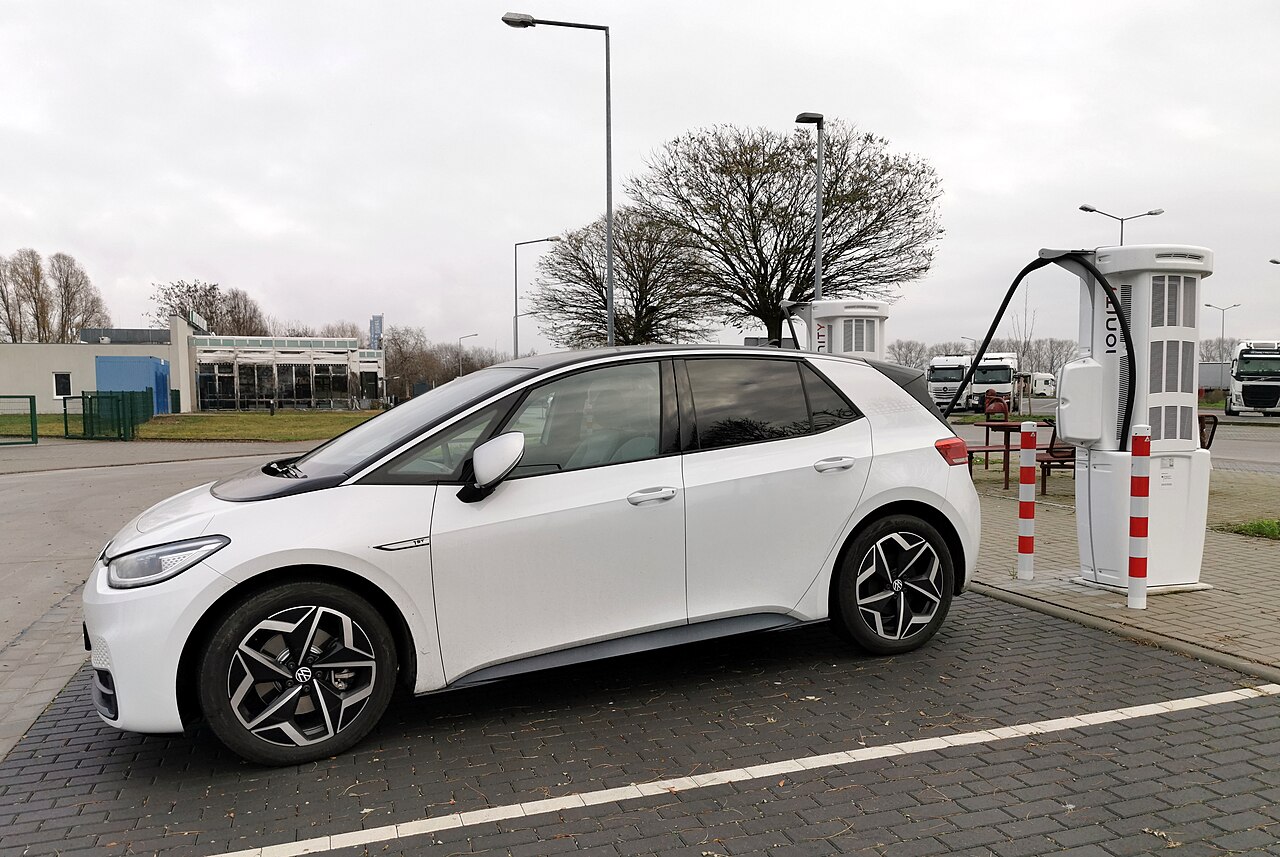

The pricing page on this site already explains why the same charger can bill three different amounts depending on how you pay. There is a second, separate variable that changes the price again: when you plug in. It is a distinct question from payment method, and it is becoming more relevant as more networks adopt it.
Why time-of-day pricing exists at all
A charging site's electricity cost is not flat through the day. Wholesale electricity prices move with demand and, increasingly, with how much wind and solar generation is on the grid at that moment — cheap when supply is abundant, expensive at the evening peak when demand is highest and generation is often at its least flexible. A literature review of dynamic pricing for electric vehicle charging documents this as an established area of study, not a fringe idea: operators have real financial incentive to shift demand away from peak hours, and time-varying prices are one of the more direct tools for doing it [2].
Research on scheduling plug-in EV charging around time-of-use tariffs goes further, modelling how shifting charging load reduces both what the driver pays and the stress placed on the wider system at peak times [1]. The incentive is not one-sided — a network that charges more at 6pm and less at 2am is not simply extracting more margin, it is also trying to avoid the cost and grid strain of everyone charging at once.
What "dynamic" can mean in practice
Not all time-varying pricing works the same way, and the research literature describes at least three distinct approaches operators use.
Fixed time-of-use bands. A published tariff structure with, say, a peak rate for a few hours in the early evening and a lower rate outside it — predictable and known in advance, similar in spirit to a home electricity tariff. Work on designing charging tariff structures to improve renewable self-consumption describes this kind of banded approach as one of several structures operators can choose between, each with different effects on when people actually plug in [8].
Forecast-driven dynamic pricing. Some more recent approaches described in the literature adjust prices based on forecasts of grid conditions and renewable output rather than a fixed clock-based schedule, aiming to reflect genuinely how much strain the grid is under at a given moment rather than a rough proxy like "it's evening." Research on forecasting infrastructure needs and dynamic pricing for EV charging treats this as an emerging rather than settled practice [5].
Load-balancing across multiple chargers or sites. Where an operator manages several chargers as a group, pricing and scheduling can respond to real-time demand across the group rather than treating each stall independently. This is a more operator-side mechanism than a driver-facing feature, but it can still show up as a price difference between two visits to the same site.
The practical point is that "off-peak is cheaper" is not a universal rule with a fixed shape — it depends on which of these approaches a given network actually uses, and that is exactly the kind of detail that should be checked per operator rather than assumed.
What this means for a road trip
| Question | Why it matters |
|---|---|
| Does this network publish a time-of-use tariff, or is the price flat all day? | Determines whether timing your stop can save anything at all |
| If it varies, when are peak and off-peak windows? | Bands differ by operator — there is no universal "evening peak" hour across networks |
| Am I planning around my schedule, or the tariff's? | A long trip rarely allows waiting for off-peak pricing; this mostly benefits flexible, local, or overnight charging |
| Is the saving worth a detour or a wait? | Time-of-use discounts on public rapid charging are typically modest compared with the gap between home overnight and any public rate |
For a genuine long-distance trip, time-of-day pricing is usually a minor factor next to the difference between authentication methods covered on our pricing page — you rarely have the freedom to wait three hours for a cheaper window mid-journey. It matters far more for charging that is flexible: topping up overnight at a destination, or charging while parked for a working day, where you genuinely can choose the hour.
Where the incentive is strongest
The strongest and most consistent time-of-day effects in the research are around workplace and destination charging rather than motorway rapid charging. Work on coordinating EV charging flexibility for demand-response participation describes aggregating many chargers — the kind of setup found at a workplace car park — to shift load away from peak hours in exchange for a lower rate [7]. That is a genuinely different use case from a driver stopping for twenty minutes on a corridor, and it is worth knowing the distinction so you are not expecting a road-trip discount that the pricing model was never designed to offer.
Common questions
Is charging always cheaper at night?
Can I save money by timing a motorway rapid-charging stop?
Why does the price at the same charger change between visits?
Do all networks use dynamic pricing?

Related reading
References
Every citation below links to the original peer-reviewed record on PubMed or via DOI. Nothing here is a substitute for medical advice.
-
Optimal Scheduling of Plug-in Electric Vehicle Charging Including Time-of-Use Tariff to Minimize Cost and System Stress Suyono H, Rahman M, Mokhlis H, et al. · Energies · 2019 · Journal article DOI
-
Dynamic Pricing for Electric Vehicle Charging—A Literature Review Limmer S · Energies · 2019 · Journal article DOI
-
Dynamic Tariff Adjustment for Electric Vehicle Charging in Renewable-Rich Smart Grids: A Multi-Factor Optimization Approach to Load Balancing and Cost Efficiency Wang D, Chen X, Liu X, et al. · Energies · 2025 · Journal article DOI
-
User Cost Minimization and Load Balancing for Multiple Electric Vehicle Charging Stations Based on Deep Reinforcement Learning Xia Y, Cheng Z, Zhang J, et al. · World Electric Vehicle Journal · 2025 · Journal article DOI
-
Forecasting Infrastructure Needs, Environmental Impacts, and Dynamic Pricing for Electric Vehicle Charging Jabr O, Ayaz F, Nekovee M, et al. · World Electric Vehicle Journal · 2025 · Journal article DOI
-
A Generative AI Approach to Pricing Mechanisms and Consumer Behavior in the Electric Vehicle Charging Market Chaturvedi S, Chen E, Sharma I, et al. · Proceedings of the AAAI Symposium Series · 2024 · Journal article DOI
-
Cost-Optimal Aggregated Electric Vehicle Flexibility for Demand Response Market Participation by Workplace Electric Vehicle Charging Aggregators Chen Y, Zeng W, Khurram A, et al. · Energies · 2024 · Journal article DOI
-
Design of Three Electric Vehicle Charging Tariff Systems to Improve Photovoltaic Self-Consumption Etxegarai G, Camblong H, Ezeiza A, et al. · Energies · 2024 · Journal article DOI
-
Optimal number of charging station and pricing strategy for the electric vehicle with component commonality considering consumer range anxiety Yu W, Zhang L, Lu R, et al. · PLOS ONE · 2023 · Journal article DOI
-
Electric Vehicle Charging Scheduling and Pricing Based on Stackelberg Game Xiong Q, Zhang Z, Bazhanov A, et al. · Bulletin of Science and Practice · 2022 · Journal article DOI
-
Pole-Mounted Electric Vehicle Charging: Preliminary Guidance for a Low-Cost and More Accessible Public Charging Solution for U.S. Cities Werthmann E, Kothari V · World Resources Institute · 2021 · Journal article DOI
-
Vehicle-to-Grid in Standard and Fast Electric Vehicle Charging: Comparison of Renewable Energy Source Utilization and Charging Costs Falkoni A, Pfeifer A, Krajačić G · Energies · 2020 · Journal article DOI